

'/%3E%3Cpath%20fill='%23b2b2b2'%20d='M241%20382q0%2016%2017%2026%2017%2011%2042%2011t42-11q16-11%2017-26V269H241'/%3E%3Cpath%20fill='%239f7e00'%20d='M241%20379q0%2014%208%2023%209%209%2021%209%2014%200%2021-9%209-9%209-23V269h-59'/%3E%3Cpath%20d='M241%20339v-70h59v110q0%2014-9%2023l-6%205v-68h-15v72q-8%200-14-4v-68zm59%2040c0%2022%2015%2032%2029%2032%2021%200%2030-18%2030-32v-40h-59'/%3E%3Cpath%20fill='%239f7e00'%20d='M266%20277v5h2v12h-3v-5h2v-5h-9v5h2v5h-4v9h3v18h-5v10h34v-10h-5v-18h3v-9h-4v-5h2v-5h-9v5h2v5h-3v-12h2v-5zm42%20101q0%2010%206%2017%206%206%2015%207%2010-1%2016-7%206-7%206-17v-29h-43'/%3E%3Ccircle%20fill='%230044ad'%20cx='329.5'%20cy='372'%20r='6'/%3E%3Cellipse%20fill='%230044ad'%20cx='300'%20cy='340'%20rx='16'%20ry='21'/%3E%3C/svg%3E)
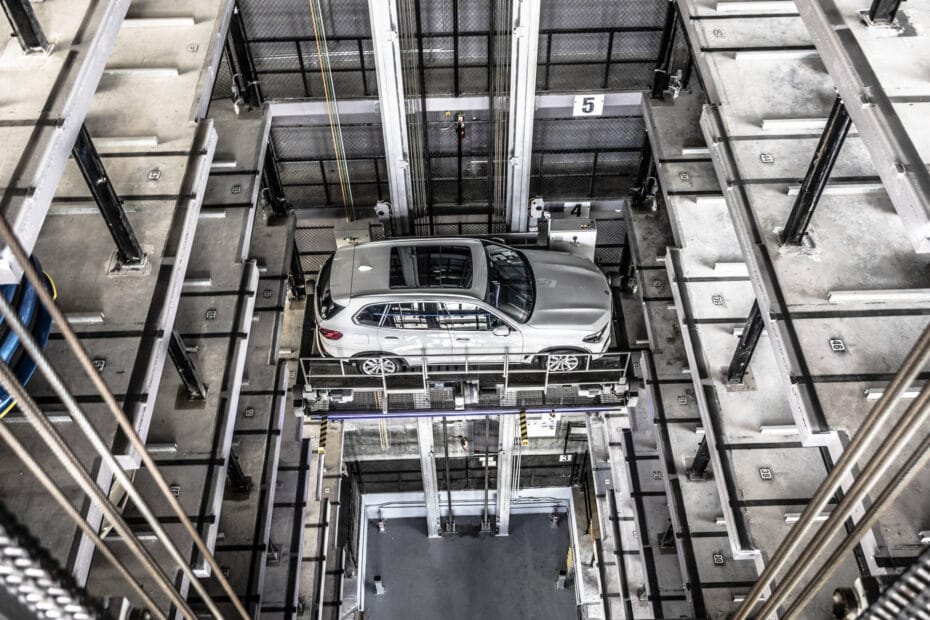
Automated parking systems (APS) — also referred to as robotic parking systems — are mechanical structures designed to park and retrieve vehicles automatically, without the driver ever entering the storage area. Rather than navigating ramps and aisles to find a free space, the driver leaves the vehicle in a dedicated transfer cabin. From that point, the system takes full control.
This article explains how automated parking systems work in practice: the five operational phases, the key technologies involved — shuttles, transfer cars, vertical transporters — and the main system configurations available today.
For a broader overview of the technology and its advantages, visit our page on Automated Parking Systems.
Automated Parking System vs Robotic Parking: Is There a Difference?
The terms are often used interchangeably — and in most contexts they refer to the same technology. Strictly speaking, “automated parking system” describes the broader category: any system that parks and retrieves vehicles without human intervention inside the storage area. “Robotic parking system” emphasises the use of robotic handling units, such as rail-guided carriers or autonomous shuttles, to transport the vehicles.
In practice, all modern high-capacity automated parking systems use robotic components. The distinction matters primarily in technical specifications and procurement — not in day-to-day usage. Sotefin designs and manufactures both, with systems engineered to specification for each individual project.
Explore the full range of Robotic Parking Systems by Sotefin.
How an Automated Parking System Works: 5 Operational Phases
The operation of an APS is coordinated by a central software platform that manages all movements within the structure simultaneously. The process breaks down into five distinct phases.
Phase 1 — Vehicle Entry and Positioning
The driver pulls into the transfer cabin — a dedicated zone at ground level equipped with laser scanners, dimensional sensors, and presence detection systems. These automatically verify the vehicle’s width and length, its correct positioning on the loading platform, and the absence of passengers or objects in the area. The driver then exits the cabin. The system will not proceed until all safety parameters are confirmed.
Phase 2 — System Activation and User Identification
Once the driver has left, the system is activated via one of several identification methods:
- Touchscreen terminal — guides the user through the parking procedure step by step, with multilingual interfaces suitable for occasional users.
- RFID badge — used in residential and corporate installations for fast, contactless access without manual codes.
- QR code ticket — generated at the time of parking and used to initiate vehicle retrieval.
- Mobile app — in advanced systems, users can activate parking, reserve a space, and request retrieval before reaching the exit point.
Phase 3 — Automated Transport Inside the Structure
This is the core operational phase, and where the handling technology makes the greatest difference in performance. Depending on the system configuration, the vehicle is moved using one or more of the following:
- Vertical transporters (lifts) — move the vehicle between levels with precision and speed. Sotefin’s vertical transporters are engineered for high-cycle operation and long service life.
- Shuttles — automated carriers that move horizontally along each level, transporting the vehicle to its assigned slot. See Sotefin’s automated parking shuttles.
- Transfer cars — travel along rails at each floor level, handling lateral movement across the storage grid. Sotefin’s transfer cars are a patented core technology used across hundreds of installed systems worldwide.
- Pallet systems — the vehicle is placed on a steel pallet carried through the system. No mechanical component ever contacts the vehicle directly. See pallet systems.
The central management software coordinates all active movements simultaneously, preventing conflicts, optimising cycle times, and managing multiple parking and retrieval operations in parallel.
Phase 4 — Slot Assignment and Storage
The system’s software assigns each vehicle to the most efficient available slot based on real-time occupancy, vehicle dimensions, and predicted retrieval sequence. Structures can be configured vertically (tower systems), horizontally (underground), or in hybrid multi-level layouts — all designed to maximise parking density within the available building volume. Automated parking structures typically accommodate 40–60% more vehicles than a conventional garage of equivalent size, because ramps, aisles, and turning areas are eliminated entirely.
Phase 5 — Vehicle Retrieval
The driver requests the vehicle via the same interface used at entry — terminal, badge, QR code, or app. The software locates the vehicle and coordinates all handling units to return it to the exit cabin. In well-engineered systems, retrieval typically takes between 90 seconds and 3 minutes, depending on the system configuration and current operational load.
Key Technologies Inside an Automated Parking System
PLC-Based Control Software
A Programmable Logic Controller (PLC) acts as the operational brain of the system. It manages all movement commands, monitors sensor data in real time, handles error detection and safety interlocks, and sequences parallel operations. In Sotefin systems, the PLC software is developed entirely in-house, allowing full control over system logic and enabling remote diagnostics from any location.
Safety Sensor Architecture
Multiple sensor layers operate throughout the structure: at the transfer cabin (dimensional verification, presence detection), along transport paths (position feedback, obstacle detection), and at each storage slot (occupancy confirmation). No movement is authorised unless all relevant sensors confirm safe conditions.
Redundancy and Fault Management
Industrial-grade systems are designed with redundancy at critical points — backup power for control systems, alternative routing logic, and fail-safe parking positions. This ensures that even in the event of a component fault, vehicles remain safely stored and the system can recover without manual intervention.
Remote Monitoring
Modern APS installations include remote monitoring capabilities, allowing the operator — or Sotefin’s technical team — to access real-time diagnostics, performance data, and fault logs from any location. Remote support is part of Sotefin’s standard long-term service offering.
Main Types of Automated and Robotic Parking Systems
Shuttle-Based Systems
Automated shuttles move vehicles horizontally at each level while vertical transporters connect the floors. Well suited to medium-to-large residential and mixed-use developments, shuttle systems offer a strong balance of throughput and retrieval speed.
Transfer Car Systems
Transfer cars handle lateral movement at each level in combination with vertical lifts. Highly scalable and reliable, this configuration is widely used in large-capacity commercial and urban projects. Sotefin’s patented transfer car technology is a defining element of its product range.
Tower Parking Systems
Vehicles are stored in a vertical tower structure, with a central lift transporting each car to its assigned level. Traversing towers are particularly effective in high-density urban areas with a very limited ground footprint.
Puzzle Systems
Mobile platforms shift vertically and horizontally to free the requested vehicle. Commonly used in small residential buildings, though retrieval may require several intermediate movements before the target vehicle is accessible.
Rack & Rail / Pallet Systems
Rail-guided robotic carriers move each vehicle directly to its slot without repositioning other cars, enabling faster cycle times and higher overall reliability — a preferred configuration for large-scale installations. See Sotefin’s pallet systems for technical details.
Why System Engineering Determines Real-World Performance
An automated parking system is not an off-the-shelf product. Its real-world performance — retrieval times, reliability, maintenance requirements — depends on how the system is engineered for the specific project: building geometry, daily throughput, vehicle mix, peak demand patterns, and local technical standards.
Sotefin has been engineering custom automated and robotic parking systems since 1956. Every installation is designed from the ground up, with mechanical components and control software developed and tested in-house. With over 500 systems delivered in more than 30 countries, Sotefin’s approach prioritises long-term reliability at every stage — from feasibility to remote support.
Discover the full range of Sotefin products — including shuttles, transfer cars, vertical transporters, traversing towers, and pallet systems — or explore our sustainability and EV integration approach.