


Automation and robots are transforming automated parking systems in smart cities, integrating engineering, software and safety. In recent years, the word robot has become part of everyday language. It is commonly associated with manufacturing, logistics, healthcare, and increasingly with smart cities and urban mobility. Very often, however, the term is used in a generic way, evoking images of humanoid machines or devices with almost human intelligence.
In reality, the most widespread and advanced robots are often invisible. They operate behind the scenes, in industrial and infrastructural environments, performing complex tasks autonomously, safely, and with an extremely high level of reliability. This is precisely where automated parking systems come into play—one of the most concrete and mature applications of modern robotics in the urban environment.
What Do We Really Mean by “Robot”?
From a technical perspective, a robot is not necessarily an anthropomorphic machine. A robot can be defined as a mechatronic system capable of perceiving its environment, making decisions, and executing actions autonomously, based on control logic and dedicated software.
According to this definition, many systems we use every day—often without realizing it—are part of the robotics world: automated warehouses, production lines, autonomous vehicles, and, indeed, automated parking systems.
Automated Parking Systems as Complex Robotic Systems
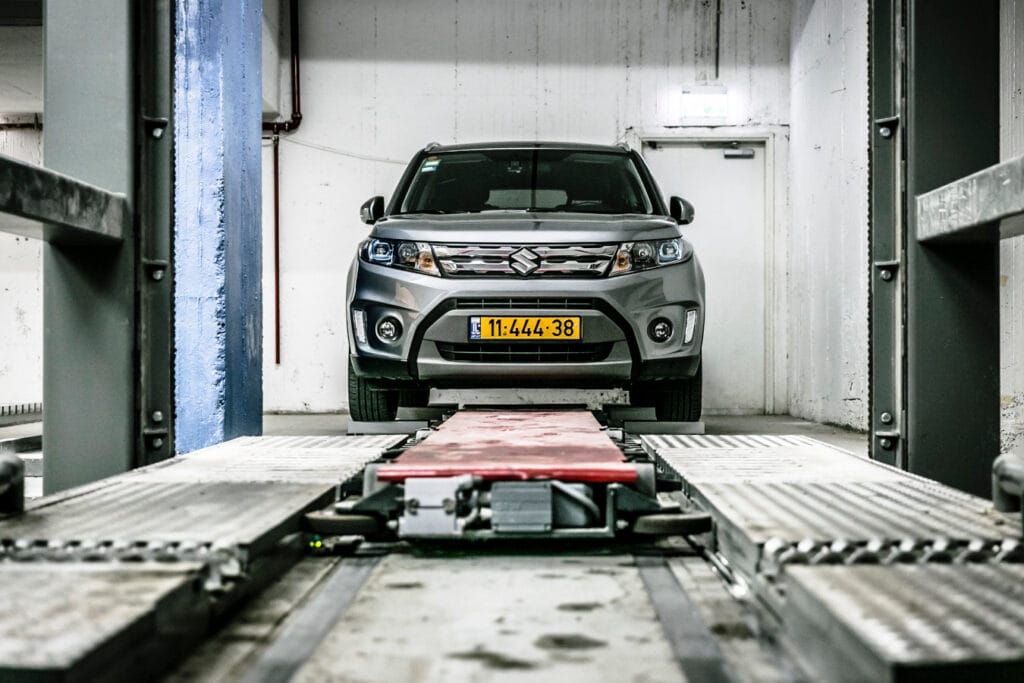
A modern automated parking system is far more than a mechanical structure that moves vehicles from point A to point B. It is a complex robotic system, composed of:
- autonomous handling units
- position and safety sensors
- control and supervision software
- traffic flow optimization algorithms
- remote monitoring and diagnostic systems
The coordinated interaction of these elements allows vehicles to be parked and retrieved without human presence in the storage areas, drastically reducing human error while increasing safety, reliability, and operational efficiency.
From this perspective, automated parking represents one of the most advanced and tangible examples of robotics applied to the urban environment.
AGVs and Automation: the “Body” of the Parking Robot

In the industrial world, the term AGV (Automated Guided Vehicle) refers to autonomous vehicles capable of moving within a system without human intervention. Similar concepts are applied in automated parking systems through transfer carts and vehicle-handling devices.
These systems:
- operate in confined and highly regulated environments
- follow optimized trajectories
- constantly communicate with the central control software
- are designed for 24/7 operation with extremely high safety standards
Conceptually, these are specialized industrial robots, engineered to perform a specific task with maximum long-term reliability.
Software: the “Brain” of the System

If mechanics represent the body of the robot, software is unquestionably its brain. In modern automated parking systems, software does much more than simply command movements—it plays a strategic role:
- managing parking and retrieval priorities
- optimizing waiting times
- monitoring system status
- detecting anomalies and maintenance needs
- enabling remote control and data analysis
This software intelligence makes the system adaptive and scalable, capable of responding efficiently to varying operating conditions and traffic volumes.
Robotics and Electric Vehicles: a Natural Convergence

The transition toward electric mobility is introducing new challenges in the parking sector. In automated systems, the absence of human access to storage areas makes conventional charging methods impractical.
This is where robotics becomes a key enabler. The evolution of automated parking systems increasingly involves:
- automatic connection to the electrical grid
- intelligent management of charging cycles
- integration between parking infrastructure and vehicles
In the near future, automated parking facilities will become active nodes of the urban smart grid, capable not only of storing vehicles but also of interacting with the electrical network and city energy management systems.
Safety, Reliability, and “Invisible” Robots
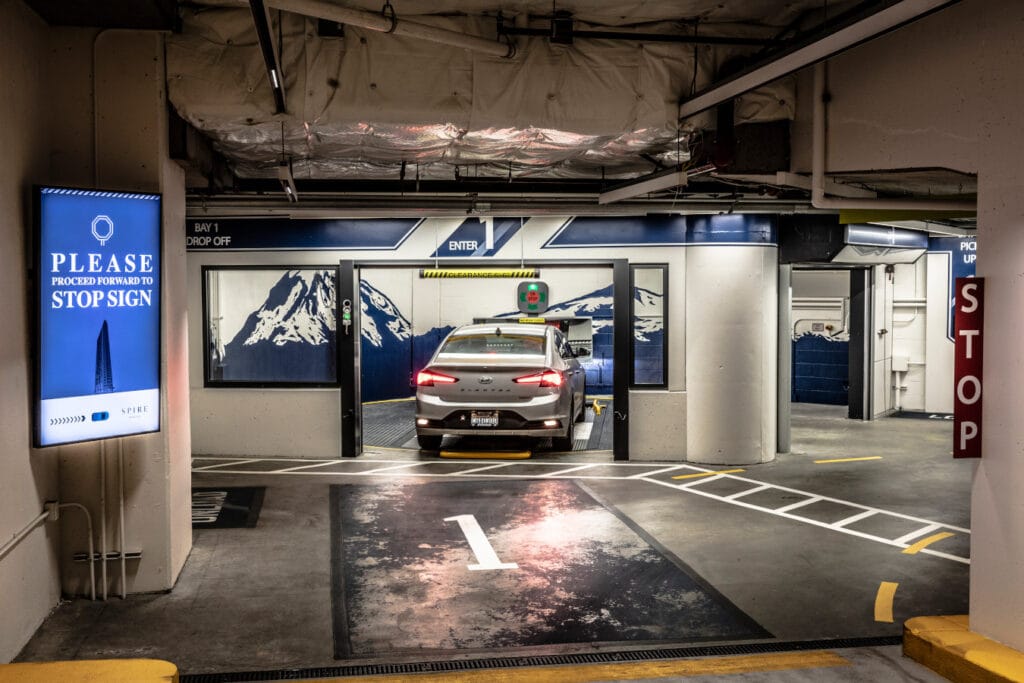
One of the least visible—yet most critical—aspects of robotics applied to parking systems is safety. Automated systems are designed to operate in environments where human–machine interaction is minimized.
Redundant sensors, fail-safe logic, strict technical standards, and extensive testing ensure that these “invisible robots” operate with levels of reliability that are difficult to achieve with manual or semi-automated solutions.
The result is an infrastructure that:
- reduces accident risks
- protects both vehicles and people
- ensures long-term operational continuity
The Future: Toward Smarter and More Autonomous Parking Systems
Looking ahead, the evolution of automated parking systems follows a clear trajectory: greater autonomy, deeper integration, and increased intelligence.
Key developments include:
- artificial intelligence algorithms for traffic optimization
- predictive maintenance based on data analysis
- integration with smart city platforms and shared mobility systems
- interaction with autonomous vehicles
In this scenario, automated parking is no longer just an infrastructure, but a robotic urban system, designed to make cities more efficient, sustainable, and livable.
Not Humanoid Robots, but Robots That Improve Cities

When people think about robots, imagination often jumps to futuristic and spectacular machines. Yet the robots that are already transforming our cities are far more discreet. They are reliable systems, engineered with rigor, operating silently to optimize space, resources, and energy.
Automated parking systems are a clear example of this “invisible robotics,” where automation, software, and mechanical engineering converge to address real challenges in urban mobility.
It is within this vision that companies like Sotefin SA continue to develop advanced solutions, contributing to the evolution of smart cities through parking systems that are increasingly intelligent, safe, and sustainable.