


The Dawn of Automated Parking
If we consider that the first forms of automated parking date back to the early 1900s, it is easy to imagine the revolution this sector has undergone—challenging, since its very beginnings, the technical expertise and creativity of the most visionary engineers.
Automated parking took its first steps in 1905 in Paris, where mechanized systems for lifting and moving vehicles were introduced. Faced with the unstoppable process of urbanization driven by the Second Industrial Revolution, population growth and high housing density made it increasingly urgent to find solutions capable of maximizing the vertical space dedicated to vehicles. To reduce the need for ramps and maneuvering lanes, cars were handled by an operator: once the driver left the vehicle in a designated bay, the system automatically moved it into a parking stall.
During the 1920s and 1930s, new inventions and prototypes appeared both in the United States and in Europe, with the vertical elevator as their common denominator. These were ingenious systems, but often hindered by extremely high costs and maintenance challenges. As a result, their adoption remained very limited for a long period.
From the Mid to Late 20th Century: The Mechanized and Semi-Automatic Era
From the mid-20th century onward, the experiments of the previous decades helped consolidate the know-how needed to develop more solid and reliable parking systems.
Starting in the 1950s, systems based on lifting and sliding platforms began to spread. The vehicle, once placed on a platform, was shifted horizontally and vertically to a free stall. These were still “park and lift” or “stacker systems,” which meant that after the driver left the car in a designated bay, the actual movement was always triggered by an operator.
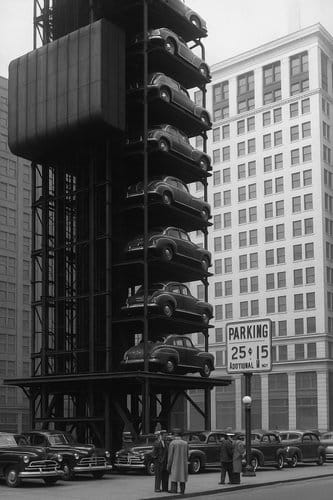
In a short time, some parking facilities began to introduce sequential systems based on conveyor belts or “Ferris wheel” mechanisms, such as rotating pallet systems capable of continuously moving cars into available stalls.
The real breakthrough, however, came with the introduction of the first forms of remote control and positioning sensors, able to detect the presence of the vehicle. Remote operation made it possible, for the first time, for the operator to manage vehicle movement without being physically present on-site.
As technology advanced, the issue of safety became increasingly urgent, making it necessary to equip automated parking systems with interlocking mechanisms designed to prevent potential accidents.
The 21st Century and Intelligent Automation
The revolution of automated parking systems took off at the beginning of the 21st century, driven by the integration of information technology, robotics, and advanced vision and recognition systems.
The transition began with the introduction of the Robotic Valet: an autonomous robot that replaced fixed platforms by moving independently across the parking floor. Among the most common types are:
- Fork-type or Dolly Robot, which positions itself beneath the vehicle, slightly lifts it, and transports it to the designated stall.

Sotefin Silomat™ Dolly
- Skate Robot, which positions itself beneath the vehicle’s wheels, lifts it off the ground, and transports it.
- Movable Pallet Systems. These are not true AGVs (Automated Guided Vehicles), but rather intelligent pallets that transport the car by moving along predefined tracks. Guided by advanced management software, they can optimize routes, assign parking stalls based on vehicle size and expected parking time, and reduce waiting times by managing entry and exit queues.
- Vision and Recognition Systems, meaning cameras and 3D scanners used to assign the most suitable stall according to the vehicle’s dimensions, ensure safety during handling by detecting obstacles and anomalies, read license plates to optimize entry and exit times, and associate the vehicle with its owner or payment.
To complete this overview, we must also mention the use of intuitive user interfaces, such as touchscreen kiosks and smartphone apps that allow users to request retrievals and make reservations—making the service faster and more efficient.
As for system maintenance, sensors are employed to monitor the condition of the machinery and detect anomalies. These tools are essential for enabling predictive maintenance and minimizing downtime.
Future Challenges: Autonomous Parking and Smart City Integration
Modern automation systems are set to become increasingly integrated into the urban environment, offering a wide range of high-performing and interactive services.
In the future, it will be possible to reserve a parking space directly through MaaS (Mobility as a Service) apps, thereby integrating automated parking into a broader and global service network. This shift will encourage the use of sustainable, interconnected modes of transport: moving from private cars to shared solutions such as car sharing and public transportation. One of the most exciting prospects currently being explored is the ability for end users to request vehicle retrieval remotely—allowing the car, once moved from its stall to the exit, to reach the driver at the desired location in self-drive mode.
Although still under development, these projects highlight how automated parking has evolved from pure mechanization to increasingly sophisticated robotics, and now toward exploring the potential of artificial intelligence. In the near future, drivers will be able to benefit from a range of complementary services while their cars are parked, adding undeniable value, such as:
- Electric vehicle charging, both via robotic connectors and inductive charging
- Automated washing, through integrated mini-wash stations
- Delivery services, with parcel pick-up points inside the parking facility
- Predictive maintenance, through constant monitoring of the vehicle’s condition, detecting required interventions in advance