


Technical Benefits Across Building Types, Urban Contexts and Development Strategies
Parking is often treated as a secondary function in real estate development. In reality, it is one of the most space-intensive, technically restrictive and financially influential components of a project. Conventional parking requires ramps, turning radii, drive aisles, ventilation for circulating vehicles, clear heights, pedestrian protection measures and significant structural coordination.
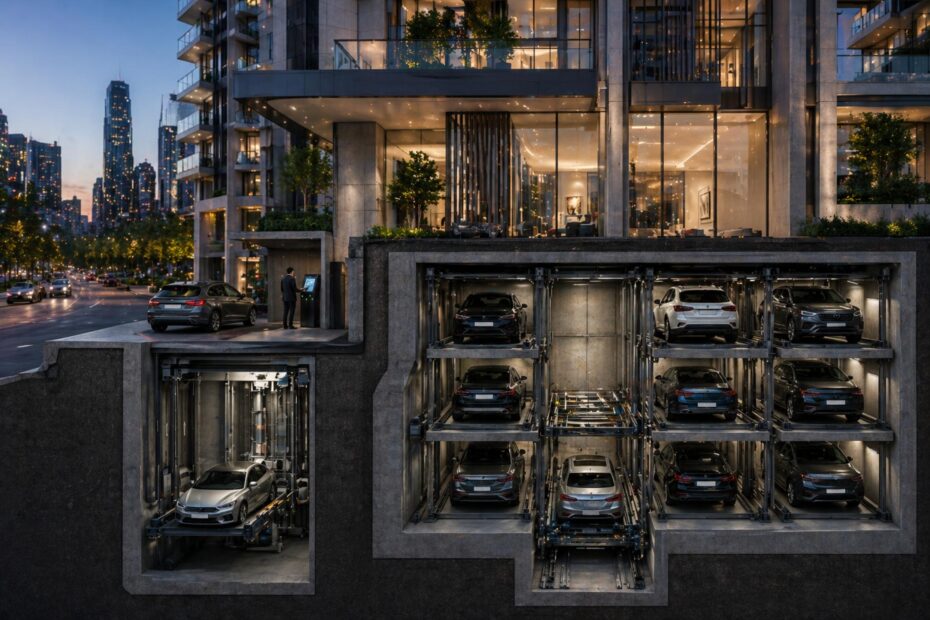
Automated parking systems — including the robotic handling technologies Sotefin has been engineering since 1956 — change this equation entirely. By separating the user from the vehicle storage area and moving vehicles through controlled mechanical handling, they transform parking from a passive cost centre into an active design tool.
For developers, architects, investors and municipalities, the value of automation is not limited to “more cars in less space.” The real advantage lies in how different project types can unlock different benefits depending on density, land value, mobility patterns and operational goals.
Sotefin develops custom-made automated parking solutions, engineered around each site’s geometry, required throughput, structural constraints and user expectations. That project-specific approach is essential, because the advantages of automation depend on context.
The Core Technical Advantages of Automated Parking Systems
1. Higher Space Efficiency
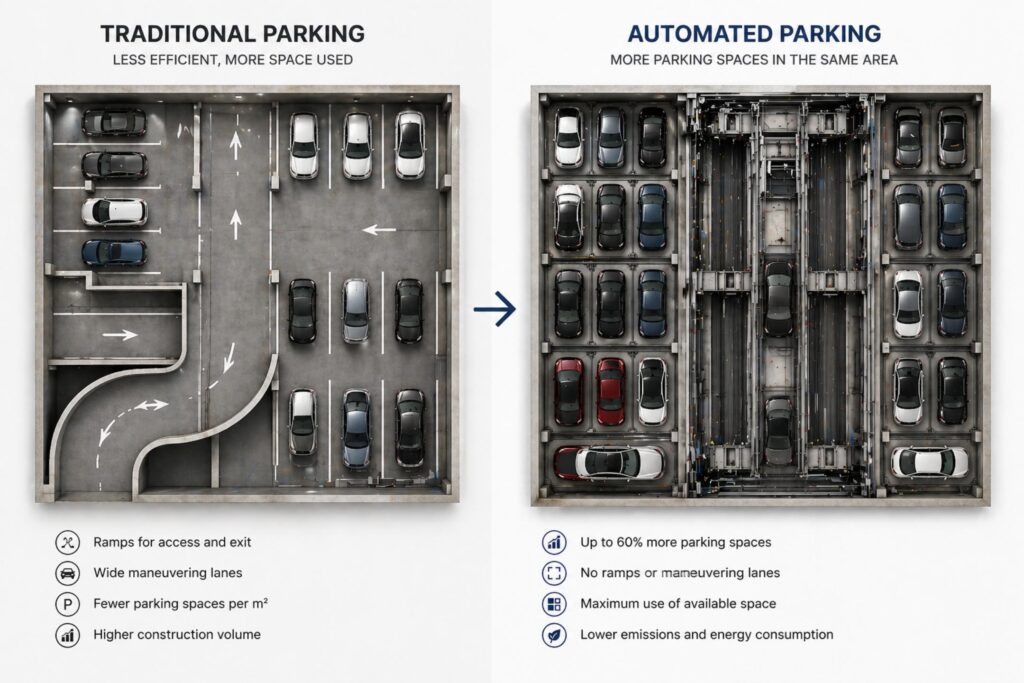
Traditional parking consumes area not only for parked vehicles, but for ramps, circulation lanes, turning areas, column clearances, pedestrian paths and buffer zones. Automated systems eliminate most of these non-productive surfaces. Vehicles are stored closer together because doors do not need to open inside the storage zone and no driver movement is required.
A project can often achieve significantly more parking capacity within the same envelope, or reduce the parking footprint while maintaining the required number of spaces. Recovered square metres can be reassigned to apartments, retail frontage, storage rooms, amenities, technical rooms, landscaping or public realm improvements.
2. Better Land Economics
In high-value urban areas, every square metre has a financial impact. If parking occupies premium basement or podium area inefficiently, the entire business case can weaken. Automated parking can improve project economics by increasing sellable or leasable area, reducing excavation volume in some cases, enabling development on tighter plots, supporting higher unit counts where parking ratios apply and improving the value proposition of premium buildings. This is particularly relevant in city centres where land cost, planning constraints and density targets are strongest.
3. Improved User Safety and Security
In automated systems, users leave the vehicle in a transfer cabin or handover bay. They do not enter the storage area. This removes vehicle-to-pedestrian conflicts, reversing accidents, poor visibility in basements, unauthorised access to parked vehicles, and theft or vandalism exposure inside parking decks. For residential and hospitality assets, perceived safety is often as important as technical safety.
4. Reduced Internal Traffic and Emissions
In conventional parking, vehicles circulate slowly while searching for a space, manoeuvring and queuing. This generates local emissions, tyre dust, heat, noise and user frustration. Automated systems reduce or eliminate internal circulation. The engine is switched off at handover, and the system completes the movement. This can lower ventilation demand and improve environmental quality within enclosed structures.
5. Greater Design Freedom
Ramps often dictate structural grids, floor levels and basement geometry. Removing them can simplify planning and create more flexible layouts. Architectural benefits may include cleaner basement organisation, improved ground floor activation, more efficient podium design, easier mixed-use stacking, preservation of heritage envelopes and stronger façade and public-space outcomes.
6. Smart Operations and Monitoring
Modern systems can integrate software for user access control, traffic management, diagnostics, maintenance alerts, usage analytics, remote support and energy optimisation interfaces. Sotefin’s custom solutions can be aligned with the operational logic of each asset, from residential convenience to high-frequency public usage.
Advantages by Building Type
Residential Buildings
In compact residential projects, parking often competes directly with storage, bike rooms, technical spaces and apartment layouts. Automated systems allow more units within planning limits, reduce basement congestion, improve resident security and deliver stronger value per square metre. A typical application is a narrow urban plot where a conventional ramp would consume too much frontage or basement area.
In premium residential towers, luxury buyers expect convenience, security and a seamless arrival experience. Automated systems with vertical transporters and transfer carriages deliver faster and cleaner parking, protected vehicle storage and efficient podium and basement planning. Peak arrival patterns, number of transfer cabins and retrieval expectations must be engineered specifically for the building.
Hotels and Hospitality
Hotel parking has very different dynamics: short dwell times, peaks at check-in and check-out, guest expectations and concierge service models. Automated systems support elegant arrival sequences, reduce back-of-house congestion, ensure secure guest vehicle handling and improve the use of valuable ground floor area. Systems based on shuttles and transfer carriages are well suited to hospitality contexts where throughput and reliability are critical. System sizing must reflect simultaneous demand, not only total number of spaces.
Office Buildings
Office parking typically experiences concentrated morning arrival peaks and evening exits. Automated systems handle commuter flows efficiently, reduce basement circulation, create a cleaner corporate environment and integrate with access control systems, while freeing more leasable area above and below grade. Traffic modelling is essential to define the right combination of cabins, vertical transporters and movement logic.
Mixed-Use Developments
Mixed-use schemes are among the strongest applications for automated parking because they combine different demand curves: residents, office users, retail visitors, hotel guests and service traffic — all peaking at different times. The main advantages are shared parking optimisation, better land utilisation, reduced conflicts between user groups and scalable system architecture. A generic system rarely fits mixed-use demand patterns; logic, zoning and throughput need project-specific engineering using combinations of shuttles, transfer carriages and dedicated software interfaces.
Urban Infill and Constrained Sites
Some sites are irregular, shallow, heritage-sensitive or surrounded by existing buildings. Automated systems offer viability where conventional ramps are impossible, adaptation to unusual geometries, reduced excavation impact and preservation of neighbouring interfaces — unlocking plots that would otherwise remain undevelopable. This is where engineering flexibility, through solutions such as pallet systems and compact traversing towers, becomes more valuable than catalogue solutions.
Historic Centres and Heritage Contexts
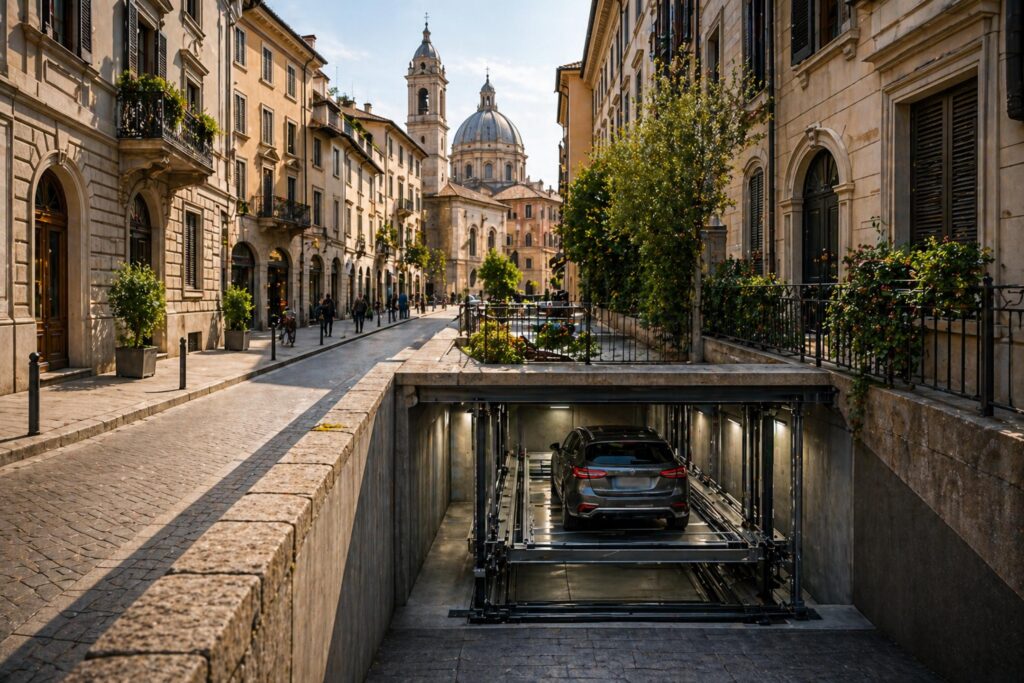
In protected areas, visual impact and excavation constraints are often severe. Automated parking provides minimal visible parking infrastructure, reduced façade impact, limited surface disruption, integration behind retained buildings and support for adaptive reuse projects. Custom structural coordination is critical in these environments, and the ability to work within tight envelopes using vehicle turning platforms and low-profile entry systems is a key advantage.
Public Parking and Mobility Hubs
Stations, airports and city parking hubs require reliability and throughput. Automated systems provide high-density storage, controlled flows, reduced search traffic, improved user guidance and data-driven operations. For these applications, redundancy, maintenance access and peak-cycle performance become central design criteria. Traversing towers and large-scale shuttle systems are particularly suited to high-volume public contexts.
Why “Custom Made” Is Not a Marketing Phrase
No two projects share the same combination of structural grid, site dimensions, access points, parking ratio requirements, user profile, peak demand curves, local regulations, budget priorities and future expansion needs. That is why Sotefin focuses on custom-made automated parking systems rather than one-size-fits-all products.
A tailored solution may involve different combinations of:
- Transfer carriages for horizontal vehicle movement across multiple lanes
- Vertical transporters for multi-level storage
- Shuttles for high-density rack and rail configurations
- Traversing towers for compact urban footprints
- Pallet systems for flexible multi-level layouts
- Vehicle turning platforms for constrained entry and exit configurations
- Multi-entry logic, phased expansion strategies and dedicated software interfaces
The right answer is not the most complex system — it is the one engineered for the real operational needs of the asset. Explore Sotefin’s full range of robotic parking system configurations.
Long-Term Strategic Advantages
Beyond construction, automated parking can also support:
- Stronger asset differentiation and higher market positioning
- Higher tenant and resident satisfaction over time
- Improved future adaptability and phased expansion potential
- Better ESG positioning through reduced circulation waste and lower emissions
- Enhanced urban land efficiency aligned with smart city goals
- Smarter facility management through remote monitoring and usage analytics
Why Sotefin
- Over 65 years of experience in automated parking engineering
- 500+ installations across 30+ countries
- Fully custom-designed systems — no catalogue products
- In-house R&D, design, manufacturing and testing
- Patented solutions developed from decades of field experience
- Long-term technical support and remote monitoring
Discuss Your Project with Our Engineers
The advantage of automated parking is not simply automation itself. It is the ability to use land, structure and user experience more intelligently. In some projects, the key benefit is extra capacity. In others, it is premium positioning, heritage integration, faster circulation, or making an otherwise impossible site buildable.
That is why the best automated parking systems are not selected from a catalogue — they are designed around the project. Contact Sotefin for a technical evaluation and discuss feasibility and system configuration for your specific development.